A Conversation with Philippe Starck, the Emperor of Design

Editor Dami Yoo | Photographer Miyeon Jeon


Today, Philippe Starck—the most influential designer at work in the world—spends monk-like days immersed in design at his secluded home in Cascais, Portugal. To Starck, whose career has unfolded with rare density over more than four decades, work is an opportunity to shape humanity's collective intelligence, to advance it, and to bring forth new ideas. That is why his designs always carry deep questions about humanity, the evolution of technology, and the future.

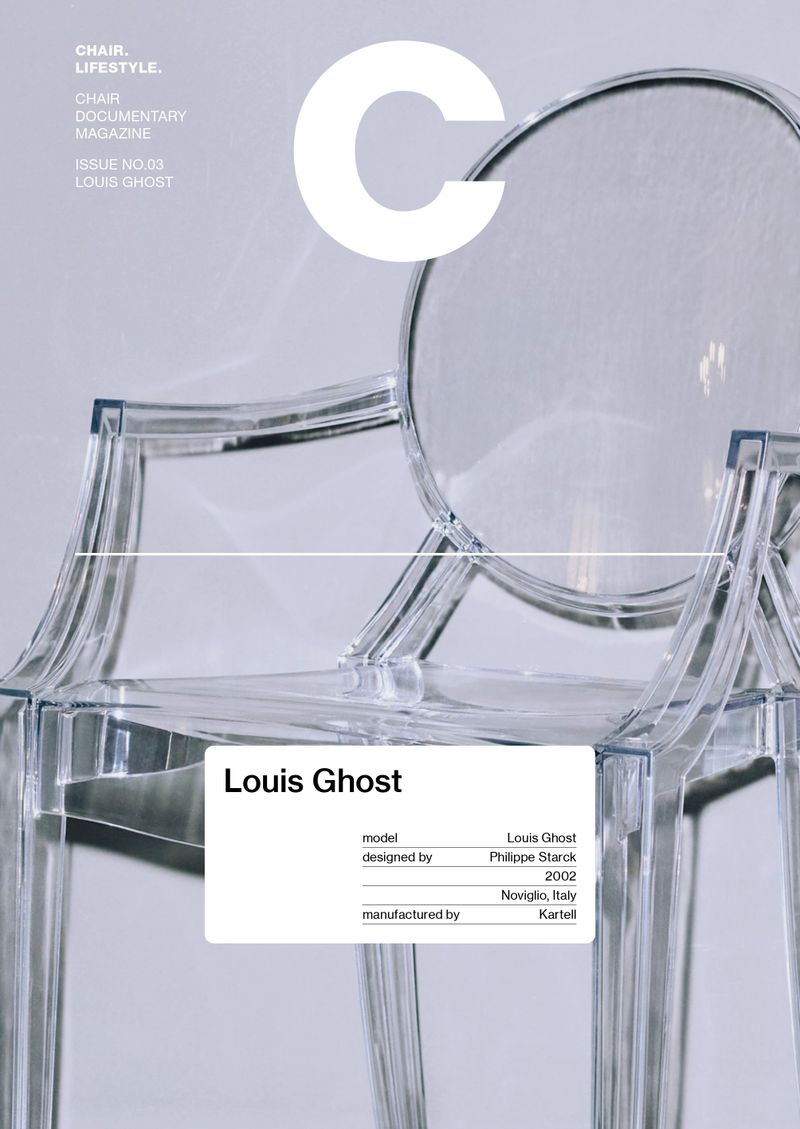
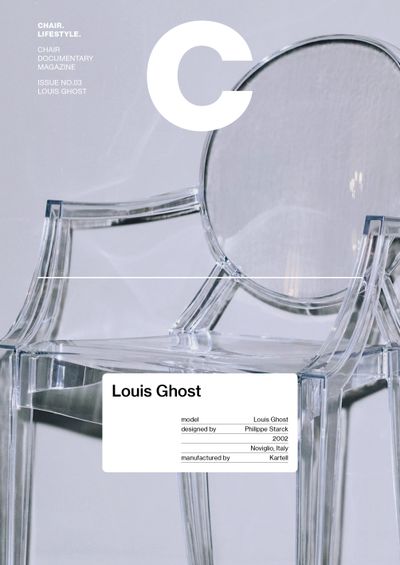
This interview appears in Louis Ghost, the third issue of Magazine C.

©Miyeon Jeon
©Miyeon Jeon
Your career—more than ten thousand projects over some forty years—is nothing short of astonishing. It is hard to imagine how you handle such a volume of work. How do you manage your working hours and your daily life?
My days are exactly the same, every day. I wake up at 6:30 a.m. at my house in the mountains of Cascais, Portugal. I take a very hot shower and finish with cold water—my own morning ritual for jolting the brain awake. After a breakfast of low carbohydrates and high protein, I sit at my desk and spread out a sheet of drawing paper. I take up a pencil and work until my head is ready to burst. In a way, I am printing onto paper what I have long imagined and dreamed. At noon I repeat the morning's schedule, living a second day until seven in the evening. In the evening I have a glass of wine or champagne, eat quinoa, read good literature, and go to bed early. This is how I live every day: work, work, and work again. To sustain deep concentration, I also listen to a twenty-four-hour playlist made for me by my friend Stephan Crasneanscki—a program of music arranged to match my biorhythm. This monastic routine is what powers the roughly 250 projects I take on each year. A few years ago, a journalist calculated that I have designed more than ten thousand objects so far. But I never design simply for the sake of designing. Before the product there is always the project, before the project there is ethics, and before ethics there is a vision.
In Impression d'Ailleurs, the book of interviews that reveals your many ways of thinking and seeing, you said that work "shapes humanity's collective intelligence, advances it, and creates opportunities to generate new ideas." It made us curious about how you actually work.
I always work alone, like a lonely cowboy. I think working with many people is wonderful, but I know it is not my way. On a mountaintop, in a forest, among sand dunes or surrounded by mud, looking out at the sea, I work with an A4 tracing pad and a Japanese criterium pencil. Surrounded by nature, I draw the vision in my head down to the smallest detail, and once it has taken shape, I hand it over to my dream team in Paris to develop in earnest. We do not meet every day, but we have worked together so long that everything runs smoothly. Each member brings their own talent, and we regard one another as family. That is how the 'Starck Network' was built.
You have collaborated with leading global brands—Kartell, Cassina, Flos, Driade, Alessi—for many years, growing with them while reflecting the times. Beyond your design sense, that is proof of your gift for partnership. How do you build and sustain such good relationships with your partners?
To complete a beautiful project, I believe you must fall in love with your partner. Love is such an essential part of our lives that I work only with friends. We meet for a project, become friends, and sometimes even become family. I love working this way—it lets us keep mutual respect and never lose our sense of humor. Above all, to design a good product you need partners who share the same values, the same ethics, the same vision.
Louis Ghost sketched by Philippe Starck
Louis Ghost, which you designed for Kartell, is counted among the most iconic and beloved chairs in the world. Molded as a single piece of transparent polycarbonate 2.0, it is a perfect union of new technology, new material, and great design. In that light, we are curious about the background and the development of ideas behind La Marie, released earlier, and the Louis Ghost series. How did these projects begin, and what was the process like?
La Marie is a chair made in pursuit of absolute 'dematerialization'—a design with the minimum of style, the minimum of weight, the minimum of material, the minimum of presence. Louis Ghost builds on the concept of dematerialization embodied in La Marie, with a touch of sensibility added. It is the result of several visions coming together.
What visions went into Louis Ghost?
The first is the dematerialization I mentioned earlier. I see the process of realizing dematerialization as humanity's evolution and its future. What humans produce must move toward less materiality and greater intelligence. The second is the power of collective memory. I believe it was not I who designed Louis Ghost but Western culture and the people who make it up. Taking the medallion chair as its motif, it is not something new—it is a form that already existed within us. My design merely served as a catalyst to awaken people's unconscious; the chair was completed by the Western collective memory and sensibility it set in motion. The third and final vision is the possibility of advanced plastic molding technology. It is an extension of democratic design—raising quality while lowering price so that as many people as possible can enjoy the product. This is a concept I pioneered long ago, and an achievement realized only today.
Could you explain more concretely the concept of dematerialization embedded in your design philosophy?
There is still plenty of matter in the world today, but in the past there was far more. Take the first computer, which was as large as a building: as technology advanced it shrank to the size of a wardrobe, then of a suitcase, and now it is small and refined enough to fit inside a wristwatch. Someday we will implant computers beneath the layers of our skin. The materiality of products is not merely shrinking—it is vanishing before our eyes. To disappear is to become more intelligent and more powerful. That is the theory of dematerialization. 'Invisibility' is bound up with the idea of minimizing matter.
Then what does the dematerialization revealed through Louis Ghost mean in terms of design?
Sometimes you need a cheerful, talkative friend, and at other times you need a friend of few words, don't you? Design is the same. There are products that are intense, assertive, 'talkative.' The character I conceived for Louis Ghost is the latter. My goal was to create an object that stays quiet, does not seize the eye, and yields space. Louis Ghost gives you the freedom to sit or not to sit, to be seen or not to be seen—the first and only case of its kind among chairs. I am also pleased by how flexibly it works across situations and moods, from stately classical interiors to of-the-moment fashion editorials. It feels as though I have fulfilled my mission of serving the community.
Café Costes, built in 1984. Located in the Les Halles district of Paris, the café added a new hospitality experience to the classic café culture of its day.
Beyond chairs, furniture, and product design, you have carried out hospitality projects around the world, from luxury hotels like Le Royal Monceau Raffles Paris to boutique hotels like Too Hotel, conjuring fantastical atmospheres in each space. What frame of mind do you bring to a spatial project?
When I work on a hotel project, I move like a stage designer or a film director. I imagine people's movements, behaviors, and emotions. What matters is creating a story that makes the air of the place resonate, and letting that story flow like music. My method is to create a mental space that leaves room for imagination. My goal is to draw people into a place where they can open their minds, cultivate their creativity, and see their dreams reflected. It is not simply about making a pretty room. I hope people leave the spaces I create carrying new ideas in their heads. What matters is not what we see, but what we feel through what we have seen and how we put it to use in our own spaces.
Projects like the Xiaomi smartphone, the Moustache Bikes electric bicycle, the crew quarters module for Axiom Space's space station, and Kartell's A.I. are signature works of yours that reflect technological progress and changing ways of living—and your steady interest in science and technology. What technological changes interest you most today?
I have always been deeply interested in science. I love and revere humanity's greatest minds, especially the scientists of antiquity. The ancient Greek mathematician Eratosthenes, for instance, measured the size of the Earth two thousand years ago with only a small margin of error, using nothing but the pace of a camel and a thirty-centimeter rod. Humans are geniuses. In the universe, humanity is the most creative animal—the animal that invents something new and finds a solution every time. Artificial intelligence in particular is one of the most astonishing inventions, and I believe it will change the world, for better or for worse. Which way it goes is up to humanity.
A.I., completed in 2019 in collaboration with Autodesk, seems to be the chair that best represents your interest in and passion for technology today. With it, you became the first designer to design and produce a chair using artificial intelligence. How did this project come about?
It began seven years ago, at a time when I had grown weary of my own creativity. I wanted to explore an entirely new territory untouched by human, cultural, or emotional influence. Looking for a friend who could help, I contacted Autodesk, then the most capable AI company in Palo Alto. I asked whether I could use their most powerful artificial intelligence program, and they agreed.
What was it like to collaborate with artificial intelligence?
First, I posed one simple question to the AI program: "Can you help our bodies rest using the least possible material and energy?" For two and a half years the AI wandered, repeating its mistakes. Just as I was about to give up, I realized that in communicating with AI I had to 'think' in reverse. So I changed the method—removing parts to create the structure rather than adding material.
From then on, the AI moved quickly and completed A.I., ultimately finding the best design for supporting the body with the least material and energy. What struck me is that although the process was entirely free of nature's or humanity's influence, the final design carried organic, plantlike lines. I consider that collaboration a truly pioneering project.
How do you see the potential of artificial intelligence, then?
Seven years ago it took considerable time to arrive at the chair I wanted; today the technology has advanced astonishingly. But I think artificial intelligence is only the most remarkable tool for doing design—as a tool for creativity, it falls short. AI still has no heart, no brain, none of the 'mad passion' that only humans possess. At least not yet.


Restaurant Kong, a Paris landmark
Le Meurice, the hotel Salvador Dalí once visited
Too Hotel, set in a skyscraper designed by Jean Nouvel
Has anyone influenced your rigorous design philosophy and future-oriented perspective?
I have always revered great scientists—Eratosthenes, Ptolemy, Einstein. But I cannot say I draw inspiration from anyone in particular. I live almost like a monk; I do not go to exhibitions or cocktail parties. When I first began designing, though, I did find something special in a few great, principled designers. Enzo Mari, for one, was among the great designers whose excellent work carried a humanitarian and social vision.
Andrea Branzi, Achille Castiglioni, Antoni Gaudí, and Vico Magistretti are also designers I admire. And I cannot leave out Alessandro Mendini. He was a wonderful man with a truly warm heart—a designer who possessed character and talent, ideas and sensibility, all at once. In the spring of 2024, it was a great honor to be invited to Io sono un Drago, his tribute exhibition at the Triennale Milano, and to present a work paying homage to Mendini's creativity.


At that exhibition we saw the work in which you imagined and expressed the inside of Mendini's head. If you were to portray the inside of your own head instead, what would it look like?
That is one of my own chief curiosities. I do not know exactly what the world inside my head looks like or how it works. If I had to describe it, my brain would be untouched by gravity—no particular order, no orientation of up, down, left, or right. The image is of a ball, very hot and ceaselessly moving, like boiling magma. I leave this magma-like subconscious to work on its own. When the magma in my head is ready to deliver something, it bursts through the surface and forms a small volcano—or sometimes an enormous one. Sometimes it turns out rather well, sometimes badly. So I must manage this magma with care: it has to give birth to good ideas and good visions. Ultimately, I hope it emerges as meaningful projects that can contribute to our society. Incidentally, my wife looks at me and says I am superhuman—that I am not from this planet. (laughs)
That is a fascinating metaphor. What, then, is the most recent magma to erupt inside your head?
Usually one boils up every day. With an average of 250 projects running at once each year, I finish nearly one project a day. It leaves me feeling as if I am nowhere and everywhere at once, and that shapes my peculiar memory. To me, the past is only an abstraction. There is no software in my head for handling the past; the only program I have is the one that thinks about the future.
Someday I may look at this interview and these photographs in Magazine C and say, "What is this? Did I really give this interview?" And my wife will answer beside me, "Yes, you did." I may not even remember being photographed at the Kartell Museo. Call me an expert in weightless living. Perhaps I work with NASA not out of luck but because my life itself is a state of weightlessness. I am rather good at creating spaces where gravity does not exist.


Want to dive deeper?

Magazine C LOUIS GHOST cover

Issue.03 LOUIS GHOST

Designed by Philippe Starck and produced by Kartell in 2002, the Louis Ghost has won worldwide acclaim as the very definition of a beautiful, sturdy, light, and transparent chair. Its classic design, modeled on an eighteenth-century Baroque chair, and the innovation of a single-mold polycarbonate body created an iconic chair of the century—transparent yet unmistakably present. Rather than commanding attention with flamboyance, it quietly gives way to its surroundings with a serene beauty, complementing any space and serving anyone in whatever way they wish. The reputation of this finely made plastic chair endures to this day.

Related Stories