A 21st-Century Modernist's SoHo Apartment

Editor Hyunbi Shin | Photographer Blaine Davis

Five years ago, graphic designer and creative director Ruba Abu-Nimah settled here in New York's SoHo. Her space brims with an art collection gathered lovingly over the years, books lining every wall, and the secret jokes she trades with her family in everyday life.

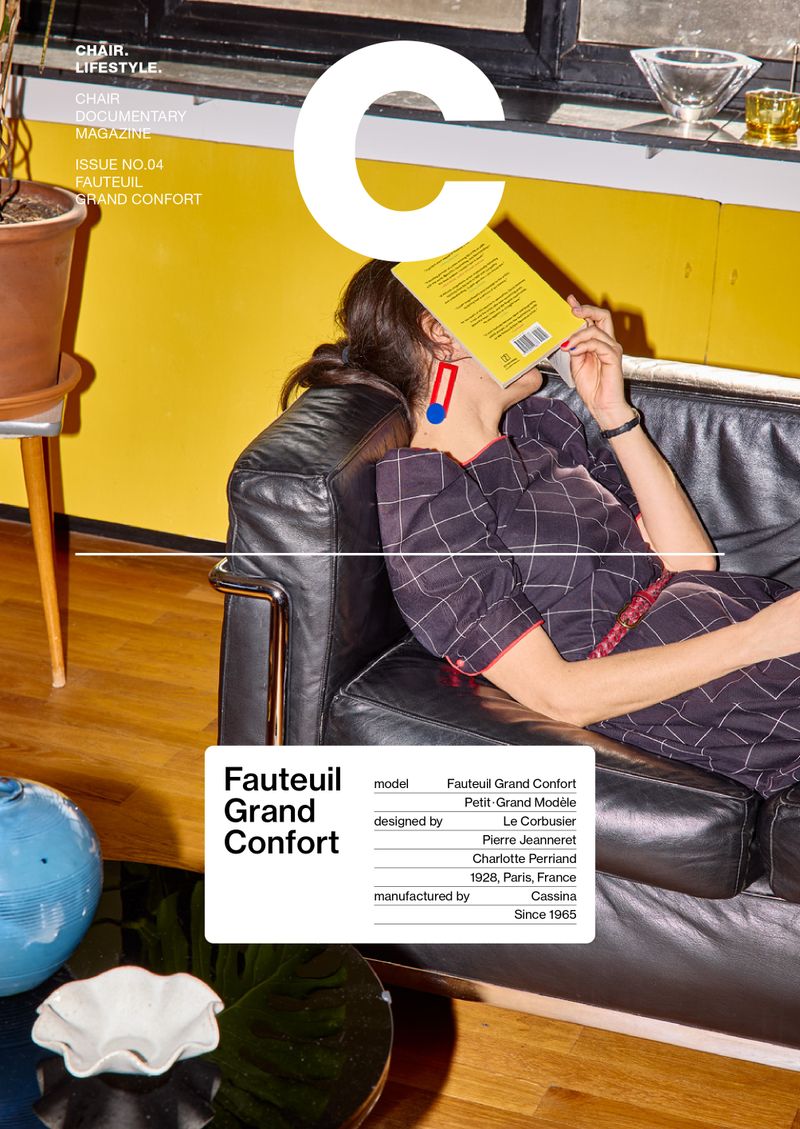
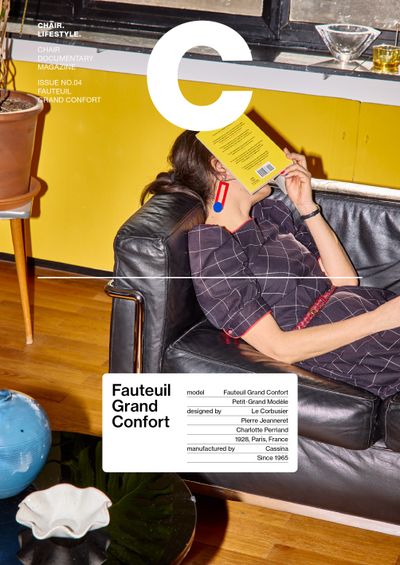
This interview appears in Magazine C Issue 4, ‘Fauteuil Grand Confort.’

© Blaine Davis
© Blaine Davis
The objects in your home—including the countless books—are the first things that catch the eye. They seem to be more than mere interior elements. Are they companions, or perhaps relics that hold their own stories?
Every object I own is meaningful in its own right. Even the ones without a practical use are connected to my interests—design, fine art, typography, ceramics, photography. I treasure surrounding myself with things that are carefully chosen, well designed, and full of meaning.
Are there also quiet inside jokes among them—things only you would understand?
Of course! My home is full of my own jokes, and they are truly precious to me. This plastic figure, for example, is Sadness from the film Inside Out—my daughter says I look exactly like her. And if you take your time looking around the house, you'll find little Super Mario toy cars from Universal Studios hidden here and there. (laughs)
© Blaine Davis
© Blaine Davis
Artworks stand out throughout the space as well. You've said you always wanted to be an art collector. What are your criteria or rules for choosing a piece?
Most of them relate to graphic design. Take the May 68 protest posters I found at a flea market in Paris, which I keep carefully framed—works like these are historically significant, but because they were never considered art in the first place, very few survive. I also own photographs by the renowned photojournalists Larry Towell and Danny Lyon. And one of the pieces I cherish most is a painting by Sho Shibuya, a brilliant artist who is both a friend and a colleague. I was quite persistent about getting my hands on it.
© Blaine Davis
© Blaine Davis
© Blaine Davis
© Blaine Davis
How do you choose your furniture, then? I'm curious why you chose the Fauteuil Grand Confort that commands the center of your living room.
When I was choosing my first furniture as an adult, nothing I saw felt right—except the Fauteuil Grand Confort. I'm a modernist at heart, deeply drawn to the Bauhaus philosophy, at once intellectual and defiant. It's astonishing that furniture from the early twentieth century still holds its beauty and value. Simply having these pieces in my space brings me enormous joy. Every home I've lived in has had a Fauteuil Grand Confort—I've never once considered buying any other sofa or armchair.
© Blaine Davis
© Blaine Davis
How do you usually spend your time in the Fauteuil Grand Confort?
Mostly reclining. Surprisingly, it fits my body perfectly, so it's very comfortable for reading or working on my MacBook. Every morning I sit here with a cup of coffee and prepare for the busy day ahead—it's the only peaceful moment of my day.
If you had to name an object that would pair perfectly with the Fauteuil Grand Confort, what would it be?
If I had to pick just one, the Vitsoe shelving system by the great designer Dieter Rams. I don't even need to explain why. I'm a devoted fan of his—I once brought a shelf from my 606 shelving system to a party Vitsoe hosted and had him sign the underside in person. (laughs)
You're currently the creative director at Moncler. How do you define yourself as a creator? I wonder how your experience with so many global brands has shaped your approach to design.
I believe graphic design is the foundation of all communication. My knowledge and skills as a graphic designer helped me understand how to deliver a message effectively for the distinct needs of different brands. I've been fortunate to work with storied names like Tiffany & Co., Revlon, Shiseido, and Elle magazine. Each brand presented its own challenges, which made the work meaningful—and above all, I had the great opportunity to work with the industry's finest talents.
If your creative philosophy were embodied in a single object, what would it be?
The iPhone. It's a design where form and function come together in perfect harmony.
Outside your work as a creative director, what inspires you most?
There are so many answers to that question. Fashion, art, history, architecture, music, the younger generation, culture—the sources of inspiration are countless. But my greatest inspiration is probably New York itself. The city never stops changing and growing, yet it remains a cultural capital of the world.
© Blaine Davis
© Blaine Davis
New York is a place where new ideas are celebrated—a city that embraces every ethnicity, race, nationality, and culture. You've spoken consistently about the importance of diversity and representation in the design industry. How important is it to uphold these values, and what do they mean to you?
Diversity is an essential value for me. I try to share my experience with young people from underrepresented backgrounds in the design industry and to help them grow through mentoring. I see this not as a matter of choice but as a principle that must be upheld. I'm Swiss, but I was born in Jordan—my parents, who are Palestinian, were forced to leave their homeland in 1948. Since then I've lived and worked in Italy, London, New York, Paris, and beyond. Each place taught me something different and broadened my horizons—I've been incredibly lucky. Travel, too, has been by far the most valuable education and experience. It helped me understand different cultures, learn new languages, and develop an eye for appreciating the value of art from around the world.
I hear you returned from a business trip to Europe two days ago. Have you gone through trial and error or faced challenges in your work?
Every day is different. Above all, I work across multiple time zones, so it's hard to keep a fixed routine. I try to focus on creative work as much as I can, but at a large company, design skills alone often aren't enough, and unexpected challenges arise. To overcome them, I collaborate with people who love art and try to create an environment where their creative energy can have a positive influence on my work as well.
If we photographed your space again five years from now, what would have changed—and what would remain the same?
In five years, I hope I'll have moved somewhere bigger. But all the furniture I have now will still be with me. If anything changes, it would just be a few more artworks and books.


Want to dive deeper?

Magazine C FAUTEUIL GRAND CONFORT cover

Issue.04 FAUTEUIL GRAND CONFORT

The greatness of the Fauteuil Grand Confort, designed in 1928 by Le Corbusier, Pierre Jeanneret, and Charlotte Perriand, does not lie simply in comfort. It became an icon of modernity through the then-novel concept of the chair as a 'machine for sitting' and the innovative use of tubular steel, the most advanced material of its time. Its form borrows the vertical and horizontal elements, modular concepts, and piloti structures familiar from Le Corbusier's architecture, recalling his assertion that a chair is architecture. In the Fauteuil Grand Confort, machine-pure form, the discipline and order born of a simple structural system, and the interplay between them come together in rich beauty—a truly great chair.

Related Stories