In the Presence of This Chair, Everything Falls Quiet
Editor Dami Yoo | Photographer Soonae Park
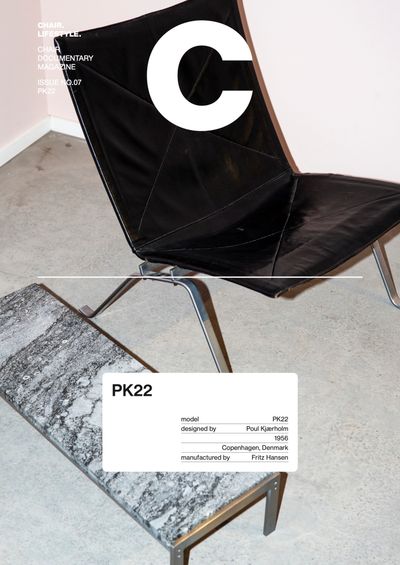
PK22 is the culmination of a structural experiment, made through the innovative production methods Poul Kjærholm established. Every element starts from function, yet precise proportions and materials pushed to their full potential give the chair an aesthetic all its own. Its simple form is built to be solid and balanced, giving it a quiet but distinct presence in a space. By drawing beauty out of structure, PK22 has become an iconic chair that expresses the essence of Kjærholm’s design in its purest form.
This article is featured in Issue 7 ‘PK22’.

Danish modern design built on evolutionary thinking
PK22 clearly reflects a defining trait of Danish design, which carries tradition forward into modern sensibilities. Grounded in the sense of proportion refined by generations of craftsmen, it introduces new materials and techniques to arrive at a lighter structure. This progression can be explained by the core attitude that has guided Danish design, the “evolutionary thinking” proposed by Kaare Klint. It is an approach that respects tradition while renewing form with the function and aesthetics of its time.
Kjærholm’s experiments with steel structures began with the Element Chair (PK25), his graduation project in 1951. Made from a single sheet of steel folded to form the backrest, seat, and legs, it was an experimental attempt to explore the elasticity and structural potential of metal. Kjærholm later developed the core idea of the Element Chair in PK22. He divided the continuous steel frame into legs and a seat, creating a more refined and stable structure. He also moved the crossbar, considered a flaw of the Element Chair, beneath the seat so that cold metal would not touch the body. The rope-wound back and seat of PK25 were replaced with canvas, leather, and cane for firmer seating. PK22 also shows that the way Poul Kjærholm absorbed the industrial functionalism of the Bauhaus and built his own formal language was itself grounded in evolutionary thinking.
Every element of PK22, from the steel frame, leather, and cane down to a single screw, serves as functional structure while also forming the chair’s visual identity. This reflects a faithful continuation of the Bauhaus belief that material and structure become form. It is exactly as Poul Kjærholm once said: “What I want to express is the language of the material itself.” Working in a Danish furniture industry centered on wood, Poul Kjærholm pursued new experiments in steel and extended the precision of traditional craft into a modern formal language. With PK22, he marked the decisive moment when Danish design moved from craftsmanship to modern industrial design.
An innovative manufacturing system
PK22 is the culmination of an innovative manufacturing system built by Poul Kjærholm and his business partner, Ejvind Kold Christensen. The two shared the same ambition to produce furniture of the highest quality through rational methods and at reasonable cost. This shared conviction led to a close partnership, and in 1955 they founded a company together and set up a new production system to make it a reality. Their approach moved away from traditional, craftsman-led production in a single workshop toward a system that specialized and distributed each process. Every stage of furniture making was broken down so that multiple subcontractors could each specialize in producing individual components.
This system of divided labor and modular assembly was an innovative way to maximize production efficiency while maintaining the quality of each component. It also allowed Kjærholm to realize both the spirit of craftsmanship he pursued and economic rationality. Every element of PK22, including the steel frame, leather seat, rubber rings, and screws, was produced separately by specialist workshops in each field. The finished parts, all of the highest quality, were shipped together in a single box and designed so that users could assemble the chair themselves. This approach to distribution was unprecedented in the Scandinavian furniture industry at the time.
It can be read as an efficient idea for reducing shipping costs. It can also be seen as Kjærholm’s minimalist philosophy, which sought to remove unnecessary steps and keep only the essentials, extended into production. This distribution method also played a decisive role in reaching overseas markets. The knockdown system made PK22 easy to ship and exhibit across borders, and the chair drew international attention as a model that combined the precise craftsmanship of Danish design with the efficiency of industrial production. In the end, PK22 changed the manufacturing paradigm of an era and marked the symbolic period when Danish modern design shifted “from craft to industry.”


An aesthetic derived from structure
Every element of PK22 is both a functional structure and a device that builds Poul Kjærholm’s distinctive aesthetic. From the steel frame to the hex bolts joining each part and the X-shaped stitching across the leather seat, every detail stems from structural logic and functional need.
To begin with, the side profile of PK22, formed by just two lines, achieves ideal proportions and clear balance for a lounge chair. The steel frame is finished in matte satin-brushed stainless steel, which minimizes reflection and fully reveals the natural texture of the material. It is a restrained finish that emphasizes the strength of the metal while softening its cold impression with a matte surface. The frame is joined with Unbrako hex bolts. These high-strength bolts, originally used in aircraft manufacturing, offer a secure fastening that improves durability. They also make it intuitively clear how PK22 is assembled and how it works, while creating an efficient system for knockdown distribution.
The seat, made of canvas, leather, or cane stretched directly over the frame, completes an extremely simple yet elegant silhouette. Its structure, as simple as a hammock yet precisely calculated, steadily supports the body the moment someone sits down, offering a distinctive comfort without any cushioning. In the leather version, a hidden lining inside the seat can be adjusted with laces like a corset, keeping the seat taut.
The X-shaped stitching on the surface also keeps the leather from stretching in only one direction, helping it hold its shape even after years of use. The cane version is made by weaving 2.5 mm cane onto the frame, and it resists deforming even without a lining. In short, PK22 balances the strength of steel with the warmth of leather, cane, and fabric. Free of unnecessary ornament, it reaches the height of refinement through precise detail.
As a result, Poul Kjærholm won the Grand Prix for PK22 at the 11th Milan Triennale (Triennale di Milano) in 1957. The following year, he received the Lunning Prize, the most prestigious award for design and applied arts in the Nordic countries.
The source of its presence
PK22 is a chair that makes a strong statement through minimal design. It blends naturally into its surroundings while giving a space a new atmosphere and sense of order. The low, wide seat and gentle curves comfortably support the sitter’s posture and visually settle into the space. The seat is joined to the legs with a deliberate gap between them, and the legs extend diagonally before turning outward to rest on the floor. These subtle design details create a sense of both tension and stability. Rather than overwhelming a space, it seems to “rest lightly” within it, and that is PK22’s greatest appeal.
Its clean silhouette, stripped of unnecessary ornament, leaves an even stronger impression. The structure is simple, yet it fully contains proportion, balance, and a sensitivity to materials. This is what Kjærholm called “quiet clarity.” The more that is removed, the sharper the form becomes, and that clarity becomes the source of its beauty.
The design qualities of PK22 carry over into Kjærholm’s other furniture, creating a cohesive world as a whole. When PK22 is placed beside the PK61 coffee table introduced alongside it, for example, it becomes easy to see why he was called a “furniture architect.” The way his pieces naturally harmonize when placed together shows that he thought of furniture as a “structure,” in other words, a module. Thanks to its concise structure and refined form, PK22 holds a quiet but distinct presence in a space. Powerful in its simplicity, it is the work that best expresses Kjærholm’s design philosophy.
Want to dive deeper?
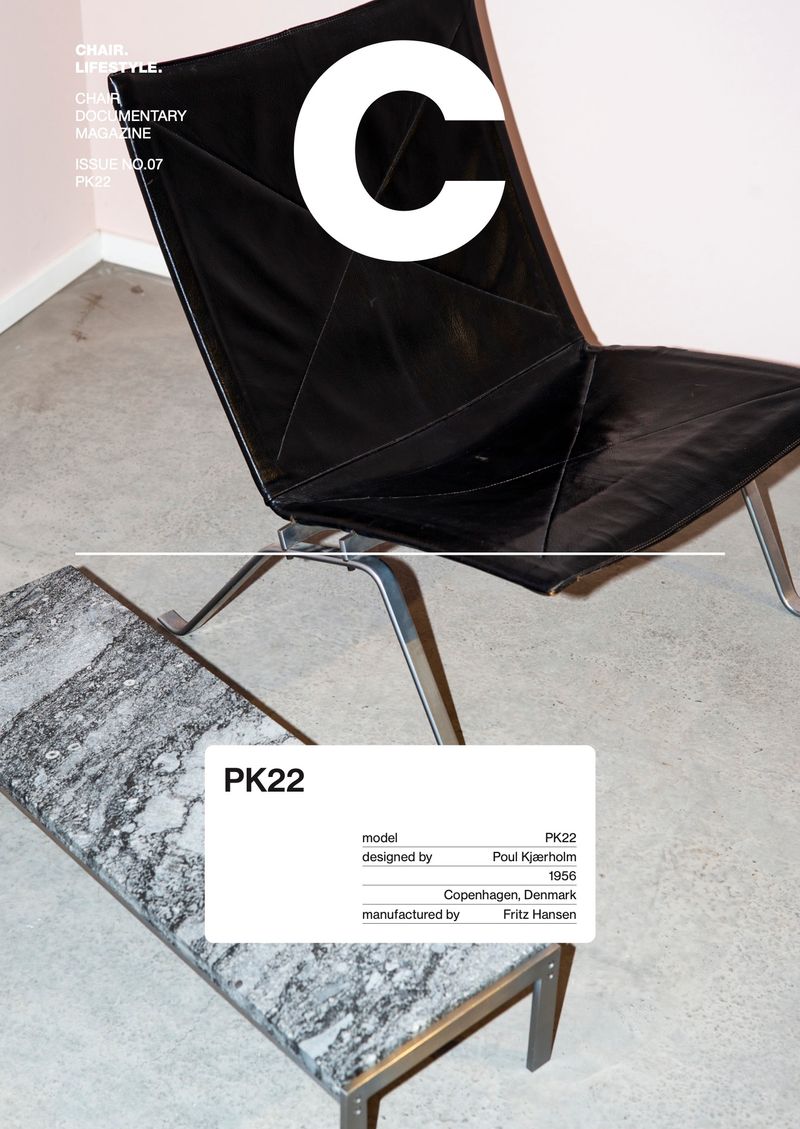
Issue.07 PK22
Introduced in 1956 by Danish designer Poul Kjærholm, the PK22 is concise and clear. Designed so that material and structure become form itself, every element of the chair—from the steel frame to the leather and screws—works functionally while shaping its sculptural identity. A defining work of Kjærholm's design philosophy, which extended the precision of traditional Danish craftsmanship into a modern formal language, it is a chair that blends naturally into any space while exerting a quiet presence.