How an Ordinary Chair Became an Icon Worth Tens of Millions of Won

Editor Dami Yoo | Photographer Sunghoon Park


Patrick Seguin, owner and founder of Galerie Patrick Seguin, has studied and championed the value and historical significance of Jean Prouvé's design more deeply than anyone. His passion took root in the late 1980s, when he came upon Prouvé's Compas table and Metropole No. 305 chair at the Saint-Ouen flea market in Paris. From then on, he traveled wherever Prouvé's work could be found, gathering and mastering the designer's legacy. By presenting these carefully selected pieces at the world's leading art markets, he helped raise Prouvé's stature and authority to the very summit of the collectible design scene.

The full interview is available in Magazine C Issue 1, Standard Chair.

You have been running Galerie Patrick Seguin for thirty-five years now. What was the journey like as it grew into a gallery that represents French modernist design?
In the beginning we dealt broadly in 1950s design, but before long we decided to devote ourselves exclusively to collecting the work of five architects and designers who worked alongside one another in mid-twentieth-century France: Jean Prouvé, Charlotte Perriand, Le Corbusier, Pierre Jeanneret, and Jean Royère. They were innovators and thinkers who put forward meaningful ideas at the crossroads of postwar industrialization and the coming age of mass production. Once we focused the gallery on these five creators, we established ourselves as a more specialized institution through exhibitions and publishing projects of varied concepts. From the 2000s in particular, we took part steadily in global art markets such as Design Miami and Art Basel, championing the value and beauty of French postwar design. We have also carried out several projects on Prouvé's architecture with Jean Nouvel, the contemporary French architect who designed our gallery space.
Among the five designers, your affection for Jean Prouvé seems especially profound. Was there a particular moment that drew you to his design?
I had been collecting contemporary art since the early 1980s and kept close relationships with many artists. In art circles, many people already shared an appreciation for Prouvé's sensibility and philosophy. I first discovered and purchased his work in the late 1980s at the Saint-Ouen flea market in Paris — a Compas desk made for school dormitories and a Metropole No. 305 chair made for cafeterias. Though they were simple designs from the 1950s, I fell for their singular beauty. I could see at a glance that this was design that transcended its time. Not long after, I opened a gallery space in the Bastille district of Paris, and anything related to Jean Prouvé has remained my foremost interest ever since.
Tell us about the collectible design scene in the 1990s, when you opened the gallery.
From the late 1980s, a new awareness of twentieth-century modernism took shape in Europe and the United States. Discerning collectors began paying attention to iconic industrial design, which set the stage for the rapid growth of the collectible design market. Some of the world's most influential art collectors — Ronald Lauder, cofounder of the Neue Galerie in New York, along with Ileana Sonnabend, Larry Gagosian, and Peter Brant — acquired pieces from our collection from the very beginning. And general audiences we met at solemn museums and lively international design fairs alike marveled at the originality and artistry of Prouvé's design. Watching responses that crossed the boundaries of exhibition format and nationality, I could not help but feel a deep reverence for him. It was gratifying to see his philosophy and pioneering design finally receive proper recognition as cultural heritage.

"I believe the Standard Chair is the consummate expression of industrial aesthetics and ergonomic principles. He drew comfort from simple design, achieved durability without sacrificing elegance of form, and handled materials with efficiency — an effort and sincerity that produced a model of timeless design."

Since the 2010s, Galerie Patrick Seguin has presented the Jean Prouvé collection in varied pairings through collaborations with some of the world's leading contemporary art galleries. How did these collaborations come about?
One day I realized that contemporary art and Prouvé's work create a certain synergy. Prouvé and the American sculptor Alexander Calder, for instance, exchanged ideas and worked on projects together throughout their lives. That is why, in 2013, we collaborated with Gagosian in New York on an exhibition pairing Calder's mobiles with Prouvé's work. In 2015, we presented the work of John Chamberlain — the American artist who made sculptures large and small from industrial scrap — alongside Prouvé's demountable houses. Though they worked in different fields, the exhibition was conceived around what they shared: both were innovators who drew out the potential of metal. Beyond Prouvé's pursuit of pioneering industrial technique and minimalist aesthetics, I found it deeply significant that he grew up in an artistic environment and maintained close ties with fellow artists.
In what sense do you consider Jean Prouvé's work pioneering design?
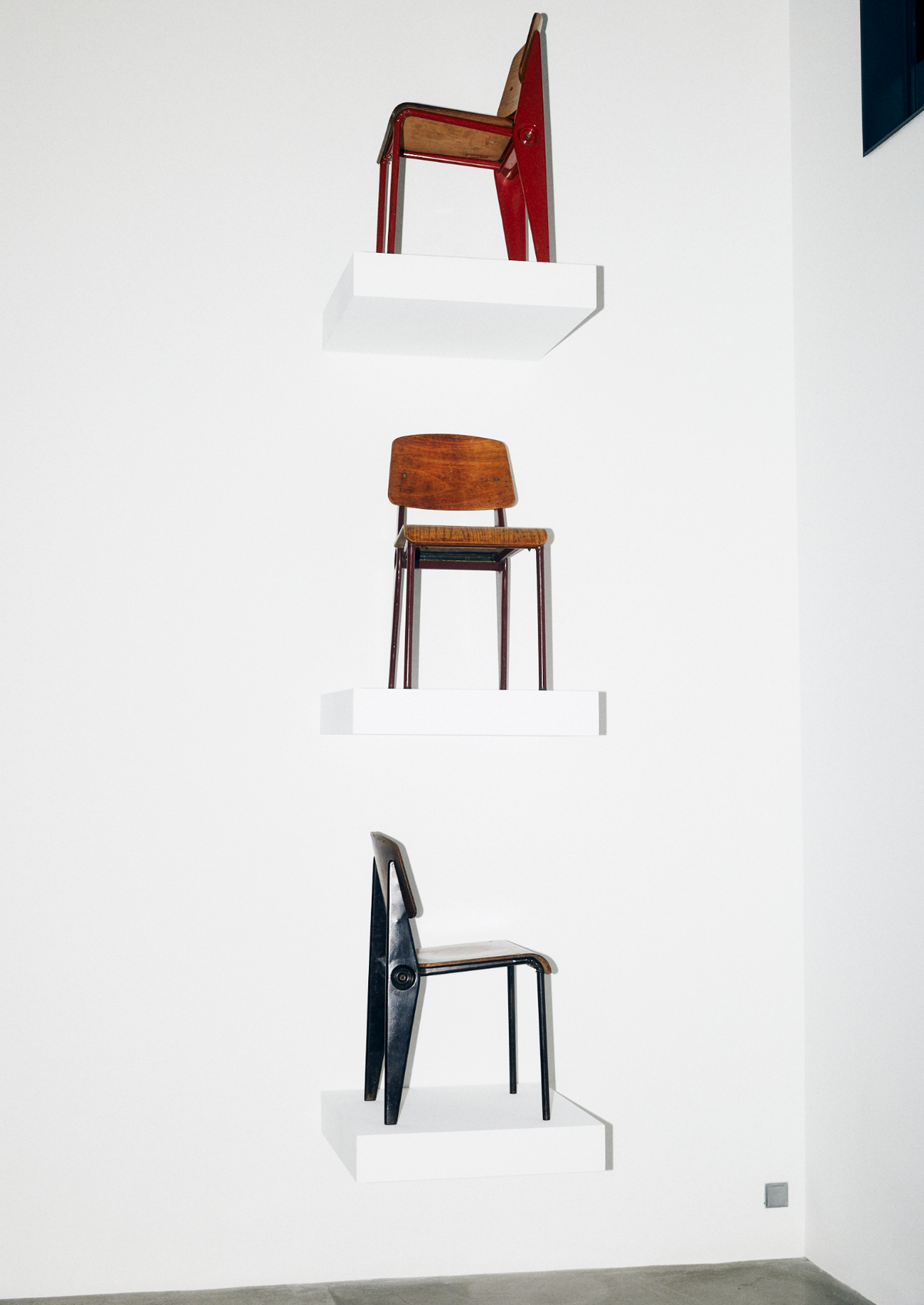
Prouvé's work harmonizes technical progress with a distinctive aesthetic sensibility. The influence of the creators around him is striking as well. He was the son of the famous painter Victor Prouvé, and he was close to Émile Gallé, the renowned glass artist who played an important role in the École de Nancy movement in the early twentieth century. Let me share an anecdote. One day Victor Prouvé explained flowers to his son, telling him that a hollow stem withstands force better than a solid one. What is fascinating is that the structural logic of Jean Prouvé's design begins right there. When making legs for furniture or supports for buildings, he used tubular structures of bent sheet steel to realize his essential principles: lightness, strength, and rationality. The legs of the Standard Chair and the compas-shaped axial portal frames of his demountable houses are likewise hollow tubes that guarantee great durability.
Among Jean Prouvé's design legacy, the Standard Chair in particular is beloved not only by design enthusiasts but by a much wider public.
Perhaps because of its perfect harmony of form and function. I believe the Standard Chair is the consummate expression of industrial aesthetics and ergonomic principles. He drew comfort from simple design, achieved durability without sacrificing elegance of form, and handled materials with efficiency — an effort and sincerity that produced a model of timeless design.
Galerie Patrick Seguin has helped establish the design of the past as an important cultural asset and a heritage worth protecting. The publishing project that brought together the vast archive of Jean Prouvé's design feels especially meaningful.
Twenty years ago we published an 800-page book on Prouvé's furniture and architecture, and five years ago we issued a revised edition. Particularly fascinating is a sixty-page section introducing the private spaces of collectors around the world who own Prouvé's work — you can see how his pieces blend harmoniously with art, architecture, and design. In fact, my own home is included (laughs). We also published, over four years, three series focused on his demountable architecture. Each series consists of five volumes, with each volume examining a single building in depth through both historical and contemporary photographs.


Galerie Patrick Seguin in Paris. Furniture by Jean Prouvé, Pierre Jeanneret, and Charlotte Perriand sits within the space designed by Jean Nouvel.
True to your devotion to Jean Prouvé, you live with his work at home as well.
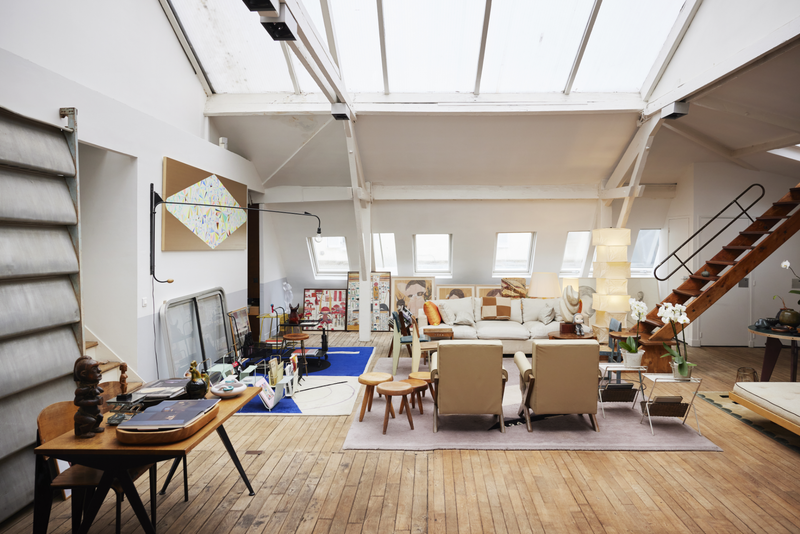
Of course. I personally own many contemporary artworks along with modernist design furniture. The Standard Chairs are set with my dining table. Prouvé's design goes perfectly with everything in my collection.
What has kept your passion for Jean Prouvé alive for more than thirty years?
The enduring value of his design motivates me constantly. Prouvé's design goes beyond mere objects — it embodies thinking outside the box, a concern for sustainability, and human-centered design all at once. Historically, too, his excellence is undeniable. His pioneering spirit and innovative technique continue to inspire collectors around the world, and his legacy is meaningful enough to serve as a cornerstone for many design lovers' journeys. As a collector, I cannot help but pour my passion into promoting and preserving his contribution.
Please share a memorable episode from your long collecting journey.
My collection, like a tightly woven tapestry, testifies to the long years I have been captivated by Jean Prouvé. The most memorable moment was the day I discovered the demountable houses and furniture Prouvé created for refugees in Africa — solutions conceived for a climate unlike France's and designed for ease of transport. Another special memory is the day in 1994 when we moved 454 chairs and 87 tables, freshly acquired from the Cité Universitaire, into the gallery. I have a photograph that has never been shown anywhere — I will offer it to Magazine C as a special gift.


You once described your focus on modernist design as a respect for forward-looking design. In that context, are there designers or brands you are watching now — across furniture, graphics, fashion, architecture, any field at all?
Let me name a few fashion brands. I admire Raf Simons's vision for new technical possibilities. I also find the creativity of Anthony Vaccarello at Saint Laurent and the modernity of The Row especially compelling. These brands show forward-looking design through elevated craft, a curatorial approach, and meticulous attention to detail.
Finally, tell us about your plans ahead and the issues that matter most to you.
I always focus on expanding our collection of Prouvé's architecture, and I try to keep a close eye on the contemporary art scene. As a collector, I must also remain open — sharing design's cultural heritage and helping people experience it more richly. In that regard, a recent immersive exhibition at Galerie Patrick Seguin, "Jean Prouvé, Maison Les Jours Meilleurs, 1956," which combined virtual reality with historical archives, was a major talking point. We installed the essential core of the Prouvé house in the gallery, and VR offered the experience of visiting the industrial house as it once stood on the banks of the Seine. Taking part in art fairs across the world — New York, Miami, Basel, Paris — is another important part of my plans.


Want to dive deeper?

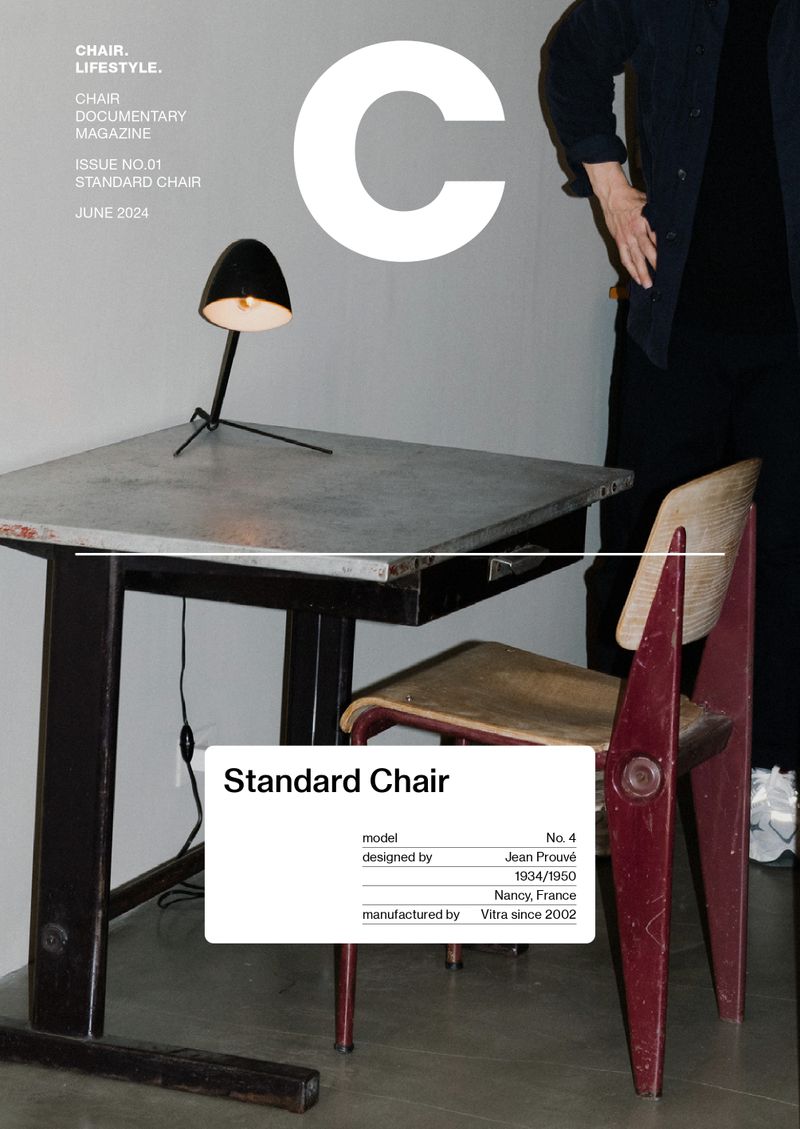
Magazine C STANDARD CHAIR cover

Issue.01 STANDARD CHAIR

The Standard Chair traces its origins to Chair No. 4, created in 1934 by French designer and architect Jean Prouvé. Over many years, Prouvé refined its materials and design, arriving in the 1950s at a 'standard' chair suited to mass production.

Related Stories