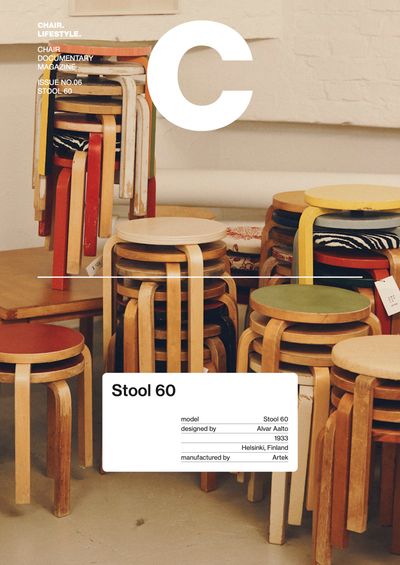
The Chair Loved by Supreme, Comme des Garçons, and Barbara Kruger
Editor Sunjin Kim | Photographer Miyeon Jeon
Made up of just a seat, legs, and nine screws, Stool 60 is now regarded as the archetypal stool. By adapting modernist principles and mass-production techniques to Finnish conditions, it became a signature work by Alvar Aalto that shows how the most local design can become global. Aalto continually refined the idea and developed its production methods and techniques.
1930s

In the late 1920s, Alvar Aalto experimented with bentwood furniture alongside the master woodworker Otto Korhonen. In the early days, every step was done by hand, as seen in the legs made from six laminated layers of wood. At times the number of layers was reduced to four. Eventually, the introduction of a bending machine made a five-layer lamination method the standard.
1940s

During World War II, the glue needed for the bentwood legs was unavailable, so the legs were made from two interlocking pieces of wood. Production continued in Finland even as factory workers were drafted and materials grew scarce. Only a very limited number were made, so this model is rare today.
1950-60s

The 1952 Helsinki Olympics brought new energy to Finnish society. Orders for Stool 60 surged, and it spread widely into homes and public spaces. To suit varied tastes, wood options such as mahogany and oak became popular alongside birch, and linoleum seats in custom colors were also offered. Artek grew as a brand and expanded its factory. By the mid-1960s, it had established a production method nearly identical to the one used today.
2010s

In the 2010s, Stool 60 became a medium for creative expression. Special editions featuring new colors, patterns, and graphics were released in collaboration with Rei Kawakubo, Tom Dixon, Barbara Kruger, Supreme, MUJI, and others.
Want to dive deeper?
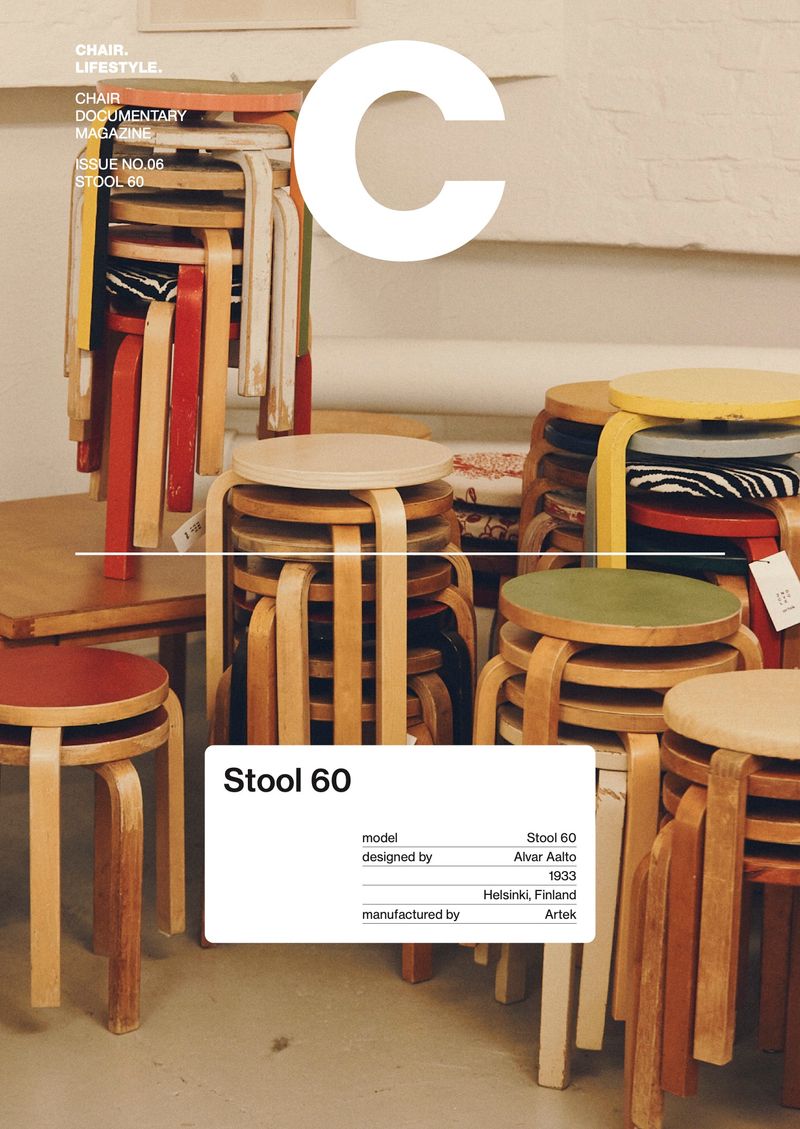
Issue.06 Stool 60
Designed in 1933 by architect Alvar Aalto, Stool 60 has long been part of everyday life in Finland. At home in kindergartens, schools, libraries, and city halls, it symbolizes the 'democratic value of design' in the way its function and use can be freely adapted to each user's needs. Aalto used dense, hard Finnish birch for durability and maximized production efficiency with L-shaped legs made of bent laminated wood. The result was a chair of broad versatility and true mass-production potential. Stool 60 may well be called the most human chair ever offered by an architect who pursued human-centered architecture.