© Miyeon Jeon

Once Upon a Time, a Curator Set Out by Mule to Collect Chairs

Editors Minjeong Kim and Sunjin Kim | Photographer Miyeon Jeon


Poitiers — a station about an hour and forty minutes from Paris by TGV. From there, another hour or so by car brings you to the Domaine de Boisbuchet. Tucked into a remote corner of the southwestern French countryside, cradled by nature, this château holds everything of design that Alexander von Vegesack, former director of the Vitra Design Museum, wishes to contemplate and savor.

Read the full interview in Magazine C Issue No. 2, "Chair No. 14."

© Miyeon Jeon
© Miyeon Jeon
You traveled as far as Germany, the Czech Republic, Austria, Poland, and Andalusia in Spain to collect Thonet furniture. You must have plenty of good stories.
In early summer I would visit the Rastro flea market in Madrid and then spend my holidays in Andalusia. With a friend and three horses, I set off into the mountains of southern Andalusia. Maps were strictly forbidden under Franco's dictatorship, so we had to pick our way along the mule tracks. At night we slept in huts warmed by charcoal fires or in inns for travelers on horseback. And it was there that I discovered some very old Thonet chairs. When I asked the owner where he had gotten them, he said he had simply kept them because he couldn't afford new ones. So I offered him the money for new chairs in exchange for the old ones.
I hear the competition among collectors to claim Thonet chairs was fierce, too.
Karl Lagerfeld, who was collecting bentwood furniture at the same time, was an opponent I could never beat at auction. His influence was such that when he put a château furnished with bentwood up for auction, Thonet prices settled back down again. Later, when Lagerfeld began collecting Memphis and Ettore Sottsass furniture, I was at last able to buy Thonet's major models at normal prices. Years later, when he visited the Vitra Design Museum, we talked about those old auctions — and afterward he sent me a framed photograph of a simple chair as a gift.
Completing the collection you have today can't have been an easy journey.
Finding old furniture catalogs was especially difficult, because Thonet lent its catalogs to branches around the world for only twelve months at a time. It was a safeguard against selling at the previous year's prices should prices rise — and anyone who failed to return a catalog was fined a month's wages, I'm told. So in the early days of collecting, finding old catalogs was impossible. The only solution was to travel to the old Thonet factories in Eastern Europe, though at the time even that was considered industrial espionage. For those trips I used an old Mercedes van that could haul furniture and double as a place to sleep. I would load up bentwood chairs found at flea markets across Europe and show them to Georg Thonet — and when I found duplicates, I sold some to him as well.
© Miyeon Jeon
© Miyeon Jeon
So you pressed on with the adventure despite Eastern Europe's tangled political situation.
We could have been thrown in prison if things went wrong. But the factories were the only place we could get information, so a friend and I went to the Czechoslovak factory and waited for people to finish work. Around six o'clock, when men who looked like architects or engineers came out, we would approach them and ask whether they could help us — whether they could get us catalogs, brochures, and the like. Sometimes the police stopped us to ask what we were doing, or to look through the inside of the van.
What was it about Thonet's bentwood furniture that stirred your passion as a collector?
The secret of Thonet's success was making a sturdy chair at a price anyone could afford, with a minimum of material and labor. Already in the nineteenth century, Michael Thonet knew what a successful furniture industry required. So he built his factory near the largest beech forests in the Austro-Hungarian Empire. He also set up a production process around an assembly line that unskilled workers — ordinary farmers, not specialized craftsmen — could handle. He promoted his products around the world through catalogs of furniture photographs, and by disassembling thirty-six chairs and shipping them in a one-cubic-meter crate, he could sell them in Latin America for less than locally made furniture.
How do you rate Chair No. 14 in particular?
Look closely at Chair No. 14 and you will find not a single superfluous part. It is light, too — one person can carry two chairs on each arm, four at a time, with ease. The seat, woven from cane, is comfortable to sit on, and in hot southern countries it breathes well. And because the chair is easy to assemble and take apart, even when one breaks, its undamaged parts can be used to repair another. It is, quite simply, the chair that symbolizes Thonet's success.
Chair No. 14 also symbolizes the leisure culture of its era — epitomized by the Viennese coffeehouse — and the emergence of a new lifestyle. What do you think about that?
I wouldn't say Thonet's chairs deliberately encouraged social life. Michael Thonet, who created Chair No. 14, moved to Vienna at the invitation of the Austrian chancellor of the day and worked for the palaces of the emperor and the aristocracy. I believe that was what allowed Thonet to conceive of new furniture and new uses for it. But it is true that people benefited from being able to buy chairs at low prices. Young people, above all, no longer had to furnish their homes with their parents' furniture. It's much like the role IKEA plays today. Thonet conquered the market with very low prices.
© Miyeon Jeon
© Miyeon Jeon
Thonet's bentwood furniture is still mass-produced as new today. Is Thonet's design still relevant?
If so many companies are still doing it, it must still be profitable. There will always be a need for simple, practical chairs at reasonable prices. I myself still love several models, such as Chair No. 14 and Chair No. 25 — the No. 25 in particular has three bentwood pieces across its backrest, which makes it wonderfully comfortable to lean against.
Several manufacturers produce Chair No. 14 today. Can any one brand claim to be the original?
I'm aware that this question matters in the vintage trade. But as far as I know, once seventy-five years have passed since a creator's death, anyone may reproduce the design. Wherever it is made, if a manufacturer today builds Chair No. 14 precisely according to Thonet's original design principles, I suppose it can be called an original. But I'm not a lawyer, and there is little reference material on the question these days — though from time to time lawyers do visit the Boisbuchet library to sort out patent issues. (laughs)
How large is your collection of Thonet bentwood furniture? And is there a model you focus on most?
About twenty years ago I sold a good part of my collection to a museum in Vienna. I kept only the pieces that mattered to the evolution of industrial design, and I find that enough. So while I still own some one hundred Thonet pieces, the truly important collection amounts to only about fifty. From the Boppard-era works to laminate samples built up from layers of plywood, I have representative pieces that clearly show the advances in technique, material, and design. If I could one day own an early Chair No. 14 — made at its most elegant, just as the bentwood technique was being perfected — I would be delighted.
© Miyeon Jeon
© Miyeon Jeon
As co-founder of the Vitra Design Museum, you developed its entire program for twenty-three years, starting in 1989. What were your criteria for collecting?
I had been collecting furniture since 1968, and I drew on that long experience to build up the Vitra Design Museum's collection. My criteria were progress and innovation in new materials, technologies, and design. Of course, I also value design that inspires. There are chairs — in a restaurant or a café, or in a home you've been invited to — that from the first glance fill you with the expectation of discovering the many secrets and new facts hidden inside them. But I am far more interested in exploring and discovering chairs in terms of the development of industrial design. Above all, building a solid, comfortable chair that can withstand every shock and strain is an extremely difficult task. Countless carpenters, designers, and architects have tried, and few have succeeded. That is also why I became interested in Michael Thonet.
Today you run Boisbuchet, exhibit your private collection, and pursue many other activities. What has kept your passion for design alive all this time?
Boisbuchet opened in the same year — the same week — as the Vitra Design Museum, and that week the Berlin Wall came down as well. We took it all as a sign of good luck. At Boisbuchet I met talented young designers I would later work with at the Vitra Design Museum, and the museum's patrons took an interest in Boisbuchet's workshops and exhibition themes and helped our work go smoothly. It was an ideal collaboration. In 2011, however, I stepped down as director of the Vitra Design Museum to concentrate on my personal project, Boisbuchet. Since then the summer workshops at Boisbuchet have grown steadily, and four years ago we introduced an additional program for artist residencies. I also curate exhibitions at the château and tour them around the world. What Boisbuchet values most is hands-on experience — something hard to come by at universities today. Thousands of people have taken part in the Boisbuchet workshops, and some return as tutors, or their children come to take part in turn. All of this is what keeps me going.


Want to dive deeper?

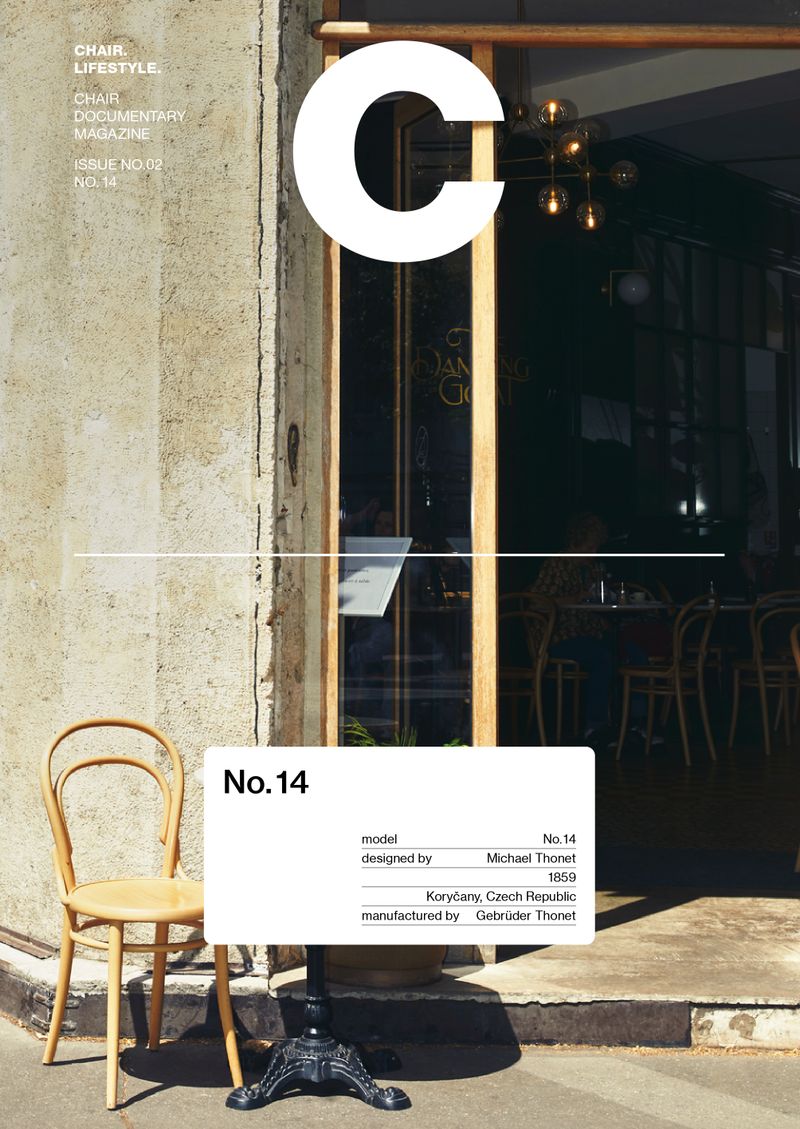
Magazine C NO.14 cover

Issue.02 NO.14

Introduced by Michael Thonet in 1859, Chair No. 14 is widely known as the 'café chair.' From the nineteenth century to the present day, it has been found wherever people gather—cafés, restaurants, and bars—across eras and borders. Thonet devised bentwood and assembly techniques suited to factory mass production, realized international distribution through flat-pack packaging, and promoted the chair through catalogs, bringing technical innovation, efficiency, and accessibility together in a single design. At the starting point of the 'modern chair'—one anyone could purchase and use at a reasonable price with consistent quality—stands Chair No. 14, with its classic design and elegant beauty.

Related Stories